Schliessen



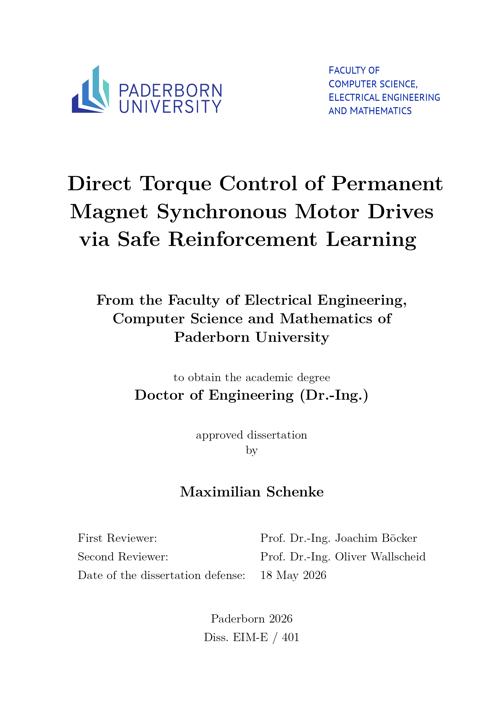
Titelaufnahme
Titelaufnahme
- TitelDirect Torque Control of Permanent Magnet Synchronous Motor Drives via Safe Reinforcement Learning / Maximilian Schenke ; First Reviewer: Prof. Dr.-Ing. Joachim Böcker, Second Reviewer: Prof. Dr.-Ing. Oliver Wallscheid
- Autor
- Gutachter
- Erschienen
- Umfang1 Online-Ressource (xvii, 102 Seiten) : Diagramme, Illustrationen
- HochschulschriftUniversität Paderborn, Dissertation, 2026
- AnmerkungTag der Verteidigung: 18.05.2026
- Verteidigung2026-05-18
- SpracheEnglisch
- DokumenttypDissertation
- Schlagwörter (GND)
- URN
- DOI
Links
- Social MediaShare
- Nachweis
- IIIF
Download
Klassifikation
Zusammenfassung
In dieser Arbeit wird bestärkendes Lernen für die Aufgabe der datenbasierten optimalen Antriebsregelung betrachtet. Der Fokus liegt dabei auf einem Machbarkeitsnachweis bezüglich der Drehmomentregelung eines Permanentmagnet-Synchronmotors. Algorithmen des bestärkenden Lernens ermöglichen die Adaption einer approximativ optimalen Regelung in direkter Interaktion mit der Regelstrecke und ohne die Notwendigkeit von mathematischen Modellen der Antriebsdynamik. Der Trainingsvorgang nach Versuch-und-Irrtum bezieht das gesamte parasitäre Verhalten in die Optimierung ein, riskiert aber die Schädigung der Anlage falls der untrainierte Regler die Einhaltung der Systemgrenzen nicht gewährleisten kann. Im Verlauf der Trainingsphase wird die Regelungsperformanz auf Grundlage einer Belohnungsfunktion optimiert, welche Drehmomenttreue und Wirkungsgrad modellunabhängig bewertet. Um Sicherheitsbedenken zu begegnen wird ein Sicherungsalgorithmus vorgestellt, der Steuerbefehle überschreibt um gefährliche Systemzustände zu vermeiden. Dieser Algorithmus wird auf den Betrieb mit diskretem (Schaltzustände des Umrichters) sowie kontinuierlichem Stellsignal (Spannung an den Motorklemmen) ausgerollt und muss gleichermaßen ohne Kenntnis der Systemparameter lauffähig sein. In der abschließenden experimentellen Umsetzung wird der Sicherungsalgorithmus, die Konvergenz des Trainings und die erreichte Drehmomenttreue betrachtet. Besonderes Augenmerk liegt dabei auf der echtzeitfähigen Implementierung, welche einen vollautomatische Trainingsablauf ohne menschliches Zutun innerhalb von zehn Minuten ermöglicht.
Abstract
In this work, the discipline of reinforcement learning is considered for approaching the task of data-driven optimal drive control. Herein, the focus is on a proof of concept for controlling the torque of a permanent magnet synchronous motor. Algorithms from the domain of reinforcement learning provide adaption of an approximate optimal controller in direct interaction with the plant system and without the necessity of mathematical models that describe the drive dynamics. The trial-and-error training phase incorporates the entire parasitic behavior into the optimization, but exposes the plant to damage if the controller operates without respecting the plant’s limitations, which must be expected during the early stages of training. Over the course of the training phase, the control performance is optimized on the basis of a reward function that is designed to assess torque tracking behavior and efficiency, and that is constructed in a model-free fashion. To address safety concerns, a safeguarding procedure is proposed that overwrites improper control actions in order to avoid hazardous system states. This algorithm is rolled out to the finite control set (inverter switching states), and to the continuous control set (applied voltage), and is subjected to the same condition of operability without available plant parameters. Finally, an experimental validation is presented, wherein the safeguarding procedure, the training convergence and the torque tracking behavior is investigated. In this context, particular focus is on the real-time capable implementation of the control algorithm, allowing for a fully automated torque controller training process that completes within ten minutes and without human intervention.
Inhalt
Statistik
- Das PDF-Dokument wurde 76 mal heruntergeladen.
Lizenz-/Rechtehinweis
